

Stackable Operator for Apache Airflow
Apache Airflow® on the
Stackable Data Platform
Run Airflow natively on Kubernetes
The orchestrator that drives data pipelines
Every pipeline you run has to start, wait, retry and hand off to the next step – reliably, every time. Apache Airflow orchestrates that, and the Stackable Operator runs it the Kubernetes-native way: the full ensemble of webserver, scheduler and workers, with security, logging and resources tuned for production. Full control over your workflows, without the operational drudgery. Run it on-prem, air-gapped or in a sovereign cloud – no vendor lock-in.
Why Apache Airflow in the Stackable Data Platform (SDP)?
Apache Airflow is a flexible, robust orchestration platform for authoring, scheduling and monitoring complex data pipelines programmatically. Its Python-based DAGs enable dynamic, conditional workflows, and in the data platform Airflow acts as the central coordinator that keeps every step running reliably and in the right order.
Dynamic workflows in Python
DAGs are defined in Python, with loops, conditionals and dynamic pipeline generation.
Scalable, modular architecture
Orchestrate an arbitrary number of workers and scale horizontally to meet large-scale workflow demands.
Reliable scheduling
Time- and event-driven execution with automatic retries, dependency management, and backfills keeps pipelines running dependably even when failures occur.
Extensive integrations
A wide range of plug-and-play operators execute tasks across Hadoop, Spark, Kubernetes and more – including the steps that train and deploy ML and AI models.
Full visibility
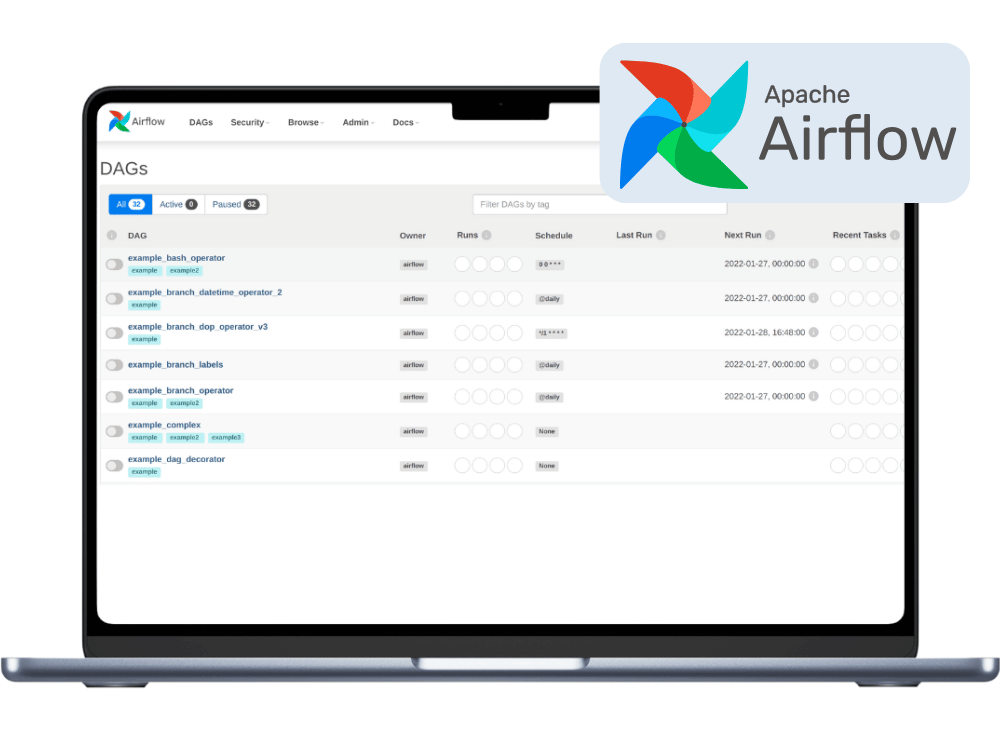
The web interface monitors, schedules and manages workflows, with full insight into the status and logs of completed and ongoing tasks.
Open source & community-driven
An Apache Software Foundation project with a vibrant community behind it.
What does the Stackable Operator add for Apache Airflow?
Pick the executor per workload
Choose the Celery executor (with Redis) for steady distributed throughput, or the Kubernetes executor to launch an isolated pod per task for elastic scaling and workload isolation. Switch modes declaratively in the CRD.
Airflow as your platform control plane
From a single DAG, launch a SparkApplication CRD, trigger ingestion into NiFi, or query datasets via Trino. Airflow drives the other Stackable operators, not just Python tasks.
GitOps-friendly DAG delivery
Mount DAGs declaratively, from version-controlled ConfigMaps or a git-sync sidecar that pulls from your repository, keeping DAG distribution reproducible and auditable.
What do all Stackable operators have in common?
One operator framework (Rust)
Every operator follows the same CRD pattern with Roles, RoleGroups and ConfigOverrides. Learn one operator, and you find your way around the next one instantly.
Infrastructure-as-Code
Every data app is a YAML CRD that lives in Git – reviewable, lintable and CI/CD-ready. The same definition works on Dev, Test and Prod.
Lifecycle management (Day-2 operations)
Deployment, restarts, certificate rotation and rolling upgrades are handled automatically – including pod restarts when configs or secrets change. And because you need to see what’s running, monitoring and logging come built in: Prometheus, Vector and OpenTelemetry feed ready-made Grafana dashboards – one observability setup for the whole platform.
Security by default
TLS, Kerberos for HDFS, OIDC login and OPA-based fine-grained authorization, all configurable per CRD. Daily vulnerability scans, SBOMs and cosign-signed images keep the whole platform patched – so you don’t track a dozen upstream projects yourself.
Kubernetes-native and modular
Runs on-prem, in any cloud or on a laptop, with no vendor lock-in – and explicit air-gapped support. Install only the operators you need, and add more later without touching the rest.
OpenShift-certified
All operators are Red Hat–certified and install directly from the Red Hat Certified Operators Catalog (OperatorHub) – compatible with Security Context Constraints and RBAC. Certified operation via a Stackable subscription.
Use Cases for Airflow
Orchestrating data pipelines
Automate ETL and ELT workflows – collecting, cleaning and loading data from many sources into HBase, OpenSearch or your data lake. With Airflow, those deployments scale reliably as workloads grow.
Scheduling machine learning & AI workflows
Data science teams schedule and monitor end-to-end pipelines, from feature extraction to model training and deployment. The operator ensures high availability and clean integration with Spark, Trino and other engines.
Real-time & batch in one place
Airflow coordinates jobs across Kafka, Spark and Superset, so streaming and batch processes run side by side and data flows seamlessly from ingestion to visualization.
FAQ - Frequently Asked Questions about Airflow and Stackable
The recommended way is stackablectl, Stackable’s CLI. It installs the Airflow operator together with all required operators in one step. Installing a Stackable Data Platform release gives you a set of operator versions tested for compatibility. If you prefer Helm, a Helm chart is available. Airflow is easy to deploy in any Kubernetes environment, without manual dependency juggling. On OpenShift, the operator can be installed via the Red Hat Certified Operators Catalog.
The Stackable Operator supports the CeleryExecutor, for distributed task execution across a pool of worker pods connected via Redis, and the KubernetesExecutor, which dynamically launches a new pod per task for elastic scaling and workload isolation. Because both are integrated with the operator, you can switch execution modes declaratively and scale resources without re-architecting your deployment.
DAGs can be mounted declaratively in the AirflowCluster CRD: ConfigMaps are ideal for static, version-controlled DAGs, while git-sync sidecars continuously fetch DAGs from a Git repository for GitOps-style workflows. Stackable’s declarative approach keeps DAG distribution reproducible and auditable, fully integrated into your Kubernetes workflows.
After deploying Airflow with the Stackable Operator, follow the Getting Started guide to run the example DAGs packaged with the operator. These are already configured to demonstrate Kubernetes-native scheduling and can be triggered directly from the Airflow UI or API – a reproducible entry point into orchestrating jobs on the Stackable platform.
Absolutely. With the Stackable Operator, Airflow becomes the orchestration layer for the entire Stackable Data Platform. From a DAG you can launch a SparkApplication CRD, trigger data ingestion into NiFi, or query datasets via Trino. This tight integration makes Airflow a central control plane across distributed data pipelines, beyond just scheduling Python tasks.
The operator uses ListenerClasses, Stackable’s abstraction for managing ingress and service exposure. Whether you need a NodePort, a LoadBalancer or integration with an Ingress controller, you can configure external access declaratively in your CRD. This keeps networking setup consistent across the entire Stackable platform and aligns with enterprise-grade security policies.
The operator provides default resource requests and limits for Airflow components, so even small clusters start with sensible defaults. For production, the docs include minimal HA examples and tuning guidance for schedulers and workers. With Kubernetes-native scaling and Pod Disruption Budgets managed by the operator, Airflow clusters grow elastically while staying stable during upgrades and node failures.
Yes. The Stackable Operator integrates Kubernetes-native best practices like preStop hooks and termination grace periods, coordinating with the operator’s lifecycle management so schedulers and workers complete active tasks before being terminated. This makes rolling upgrades and maintenance windows safer and more predictable, avoiding job loss and keeping workflows consistent.
Each Airflow pod runs with a Vector sidecar, Stackable’s standard logging solution. Logs can be forwarded to Elasticsearch, OpenSearch, S3 or other backends for unified observability across your data platform. Airflow logs are collected, enriched and shipped the same way as Kafka, Spark, NiFi and other Stackable components, simplifying monitoring and troubleshooting.
Yes. Each Airflow component is deployed with a metrics sidecar, integrating seamlessly with the Prometheus and Grafana dashboards provided by Stackable. You get out-of-the-box observability for scheduler performance, DAG runtime metrics, worker load and cluster health – without extra setup.
Yes. The Stackable Operator supports the KubernetesExecutor while adding persistent logging options. Task logs can be stored in S3, MinIO or PVCs using Stackable’s built-in logging integration, so even when task pods are short-lived, logs remain accessible for debugging, auditing and compliance.
The full specification of the AirflowCluster Custom Resource is available in the Stackable CRD Reference. It documents every configurable field – from executors and dependency management (PostgreSQL, Redis) to logging, TLS and monitoring – so you can declaratively define production-ready clusters with the same consistency as any other Kubernetes resource.
Click here for CRD reference
Supported Apache Airflow versions are listed on the Stackable documentation’s supported-versions page, refreshed with every release as new versions arrive and older ones are deprecated. You choose a version through the image in your AirflowCluster, with custom registries and custom images supported as well.
Click here for the current list
Built-in user and role management, for quick setup.
LDAP or OIDC integration, for enterprise SSO and centralized identity management.
By reusing the same identity provider integrations available across the Stackable ecosystem, you get unified authentication and authorization across all platform components.
The operator has been tested on major managed and self-hosted Kubernetes platforms: EKS, AKS, GKE, OpenShift, IONOS and K3s. This flexibility lets you deploy Airflow reliably across cloud providers or on-premise infrastructure, while still benefiting from declarative management and operator automation.
Resources - Learn how to use the Stackable Operator for Apache Airflow

Getting Started & Installation
Install the Stackable Airflow Operator (with PostgreSQL and Redis) via stackablectl, Helm or OpenShift, then deploy your first Apache Airflow cluster and run an example DAG. Includes setup steps and configuration examples.
Airflow Operator Docs
Overview of the Stackable Airflow Operator, including supported roles, executor types and key features for running Airflow on Kubernetes.
GitHub Repository
Official GitHub repository for the Stackable Airflow Operator, containing source code, documentation and configuration examples.
Demo
Example of a scheduled job in Apache Airflow, demonstrating how to define, schedule and execute tasks with the Stackable Airflow Operator.
Subscribe to our Newsletter
With the Stackable newsletter, you’ll always stay up to date on the latest from Stackable!
Newsletter
Subscribe to the newsletter
With the Stackable newsletter you’ll always be up to date when it comes to updates around Stackable!