Stackable Operator for Trino
Trino on the
Stackable Data Platform
Run Trino natively on Kubernetes
One SQL query across all your data
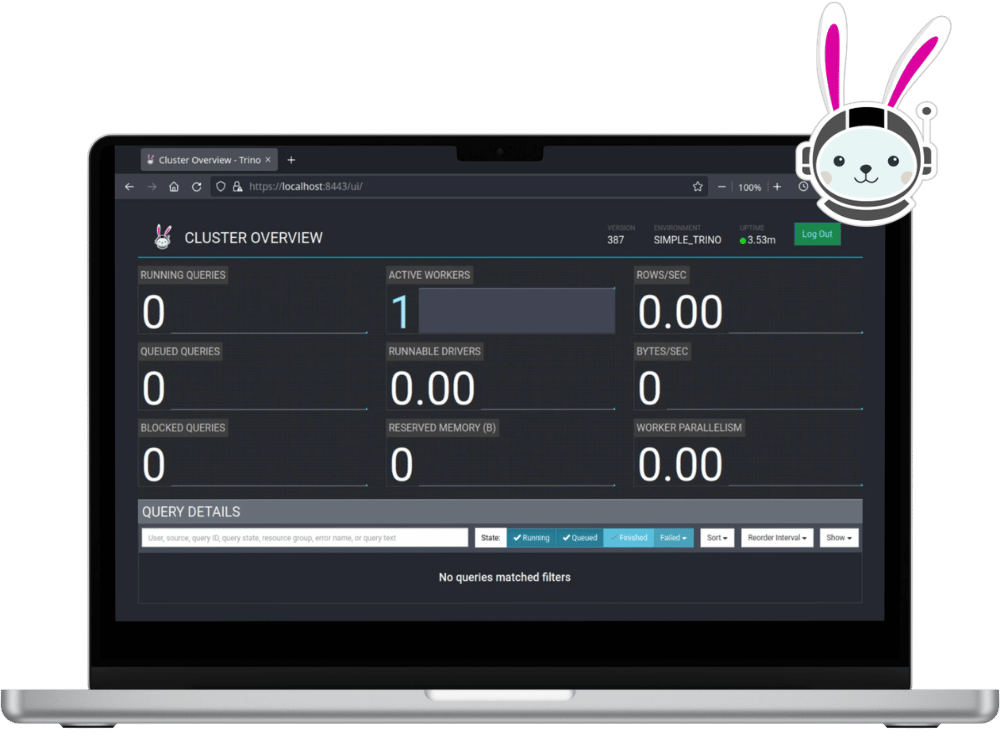
Trino runs distributed SQL over data spread across a variety of systems – HDFS, S3, PostgreSQL, operational systems never meant to be queried together – and answers everything with a single query, without necessarily moving or copying data. The Stackable Operator runs Trino clusters and catalogs declaratively on Kubernetes, with authentication, authorization, and data federation built in. Whether on-prem, air-gapped, or in a sovereign cloud – no vendor lock-in, your data stays in your hands.
Why Trino in the Stackable Data Platform (SDP)?
Trino is a high-performance, distributed SQL query engine for interactive and batch analytics. Designed for speed and flexibility, it queries your entire data estate – with or without moving or duplicating data.
Speed
Built for low-latency analytics – from sub-second ad-hoc queries to high-volume batch workloads, even on complex queries.
Enterprise-proven
Trino handles business-critical workloads into the exabyte range – from financial reporting to querying large data lakes.
Query federation
Join data across multiple systems in a single query – combining S3 object storage with a PostgreSQL or MySQL database, for instance.
In-place analysis
Query data natively in Hadoop, S3, Cassandra, MySQL and more, with no slow, error-prone copying.
Simplicity
ANSI SQL compliant and integrates with BI and analytics tools like Tableau, R and Apache Superset via standard JDBC/ODBC drivers.
Open
A community-driven project under the Trino Software Foundation.
What does the Stackable Operator add for Trino?
Manage catalogs and federate declaratively
Manage clusters and catalogs as CRDs, with every data source a version-controlled TrinoCatalog. Federate queries across Hadoop, S3, PostgreSQL and more without moving data. Long-running queries recover automatically from worker outages.
Fine-grained data authorization
OPA-based row-level security and column masking means different users see only the rows and columns they are allowed to. Analysts, BI tools and AI agents all work against a single, governed data space.
Add-on: connect BI tools via ODBC
A Stackable-built ODBC driver, written in Rust, plugs Power BI, Excel, Tableau and Python into Trino. It pushes Power BI filters and joins down to Trino in DirectQuery mode.
What do all Stackable operators have in common?
One operator framework (Rust)
Every operator follows the same CRD pattern with Roles, RoleGroups and ConfigOverrides. Learn one operator, and you find your way around the next one instantly.
Infrastructure-as-Code
Every data app is a YAML CRD that lives in Git – reviewable, lintable and CI/CD-ready. The same definition works on Dev, Test and Prod.
Lifecycle management (Day-2 operations)
Deployment, restarts, certificate rotation and rolling upgrades are handled automatically – including pod restarts when configs or secrets change. And because you need to see what’s running, monitoring and logging come built in: Prometheus, Vector and OpenTelemetry feed ready-made Grafana dashboards – one observability setup for the whole platform.
Security by default:
TLS, Kerberos for HDFS, OIDC login and OPA-based fine-grained authorization, all configurable per CRD. Daily vulnerability scans, SBOMs and cosign-signed images keep the whole platform patched – so you don’t track a dozen upstream projects yourself.
Kubernetes-native and modular
Runs on-prem, in any cloud or on a laptop, with no vendor lock-in – and explicit air-gapped support. Install only the operators you need, and add more later without touching the rest.
OpenShift-certified
All operators are Red Hat–certified and install directly from the Red Hat Certified Operators Catalog (OperatorHub) – compatible with Security Context Constraints and RBAC. Certified operation via a Stackable subscription.
Use Cases for Trino
Federated queries across sources
Connect and query data spread across HBase, Kafka, object stores and relational databases through a single SQL interface – one query instead of exporting from each system separately and stitching the results together afterwards.
Interactive analytics & dashboards
Trino powers ad-hoc analysis and BI. Connected to tools like Superset, it enables fast, interactive exploration of massive datasets, putting answers in front of decision-makers when they need them.
Data lakehouse architectures
Trino becomes the query layer on top of your data lake, with native catalogs for open table formats like Apache Iceberg and Delta Lake – making large-scale raw storage directly queryable via SQL.
FAQ - Frequently Asked Questions about Trino and Stackable
Use stackablectl operator install trino, which also deploys the required commons, secret and listener operators. Helm charts are available too if you prefer standard Kubernetes tooling. Once installed, you define your cluster and its data sources declaratively via the TrinoCluster and TrinoCatalog custom resources. On OpenShift, the operator can be installed via the Red Hat Certified Operators Catalog.
You’ll find the supported Trino versions on the Stackable documentation’s supported-versions page – new ones are added each release and older ones phased out over time. To use a specific version, set the image in your TrinoCluster; running images from a custom registry or fully customized images is supported too.
Current list
Define a TrinoCatalog for each data source (for example a Hive connector) and a TrinoCluster that uses it, then query through the Trino CLI or any compatible SQL client. The operator wires the catalogs into the cluster so the data sources are available as soon as the cluster is ready.
Yes. You can define multiple TrinoCatalog resources and link them to the same cluster, so a single SQL query can join and combine data from different sources – the core of Trino’s query federation.
The operator supports the Trino connectors that work in a Kubernetes environment, including Hive, Iceberg, Delta Lake, PostgreSQL, MySQL and more, each configured as a TrinoCatalog resource.
Trino supports file-based password authentication, LDAP and OAuth2, and multiple methods can be used together to fit your environment.
Authorization is handled via Open Policy Agent (OPA): you supply a Rego policy bundle and reference it in the TrinoCluster, enabling centralized, fine-grained access control.
The operator supports Pod Disruption Budgets and graceful shutdown, and lets you set resource requests and limits for coordinators and workers – keeping clusters stable through updates and maintenance.
Increase or decrease the number of worker replicas in your TrinoCluster CRD; the operator adjusts resources accordingly without disrupting ongoing queries.
Yes. Trino exposes Prometheus metrics that can be visualized with Grafana dashboards for performance tracking and troubleshooting.
Yes. Stackable provides an ODBC driver for Trino (written in Rust) that turns Trino’s REST API into a standard ODBC data source, so BI tools like Power BI, Excel and Tableau – as well as isql and Python’s pyodbc – can query Trino directly. It runs on Linux and Windows, supports the usual authentication methods (username/password, bearer token, client certificate or an OAuth 2.0 browser login), and ships a dedicated Power BI connector. See github.com/stackabletech/stackable-odbc-trino.

The operator has been tested on major managed and self-hosted Kubernetes platforms: EKS, AKS, GKE, OpenShift, IONOS and K3s. This flexibility lets you deploy Trino reliably across cloud providers or on-premise infrastructure, while still benefiting from declarative management and operator automation.
Resources - Learn how to use the Stackable Operator for Trino
Getting Started & Installation
Docs home for Trino operator setup and quickstarts. Step-by-step instructions for installation
ODBC Driver for Trino
A Rust-based ODBC 3.x driver that turns Trino’s REST API into a standard ODBC data source – so Power BI, Excel, Tableau, isql and Python’s pyodbc can query Trino like any other database. Runs on Linux and Windows and ships a dedicated Power BI connector.
GitHub Repository
The official open-source repository for the Stackable Trino Operator, containing source code, Helm charts and example configurations. Ideal for developers and operators who want to explore configurations, contribute or automate deployments.
Demo Tutorials
Complete data pipelines you can install with a single stackablectl command – from the New York taxi dataset queried via SQL through Trino to the Iceberg lakehouse with Trino, Spark and NiFi.
Subscribe to our Newsletter
With the Stackable newsletter, you’ll always stay up to date on the latest from Stackable!
Newsletter
Subscribe to the newsletter
With the Stackable newsletter you’ll always be up to date when it comes to updates around Stackable!