Stackable Docs Hub

Stackable

Stackable

Stackable Operator for Apache Superset

Apache Superset™ on the
Stackable Data Platform

Run Superset natively on Kubernetes

Self-service analytics without the deployment headache

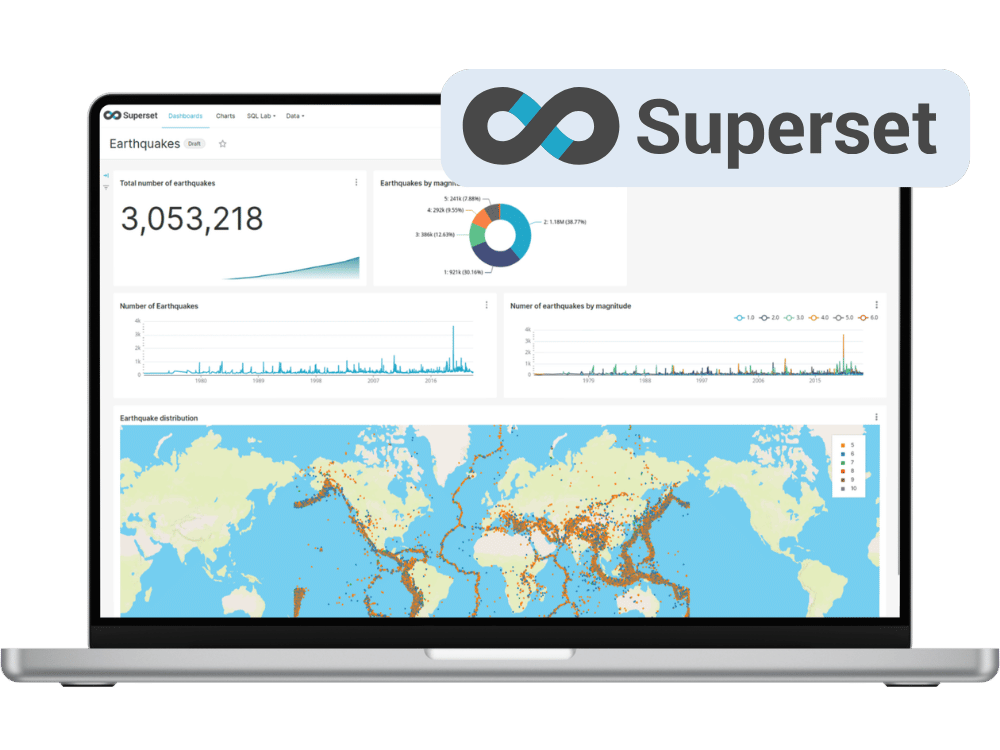
The Stackable Operator for Apache Superset runs Superset natively on Kubernetes – declarative, secure by default, and directly connected to the rest of your data platform. Teams get dashboards without the wait: data analysts explore and visualize data while access and control stay fully in the hands of the platform. Whether on-prem, air-gapped, or in a sovereign cloud – your data stays in your hands.

Superset on the Stackable Data Platform

Why Superset in the Stackable Data Platform (SDP)?

Apache Superset is a powerful tool for exploring and visualizing data – equally at home with a business user dragging together a chart and a data analyst writing SQL in SQL Lab. It connects directly to your existing databases and query engines, so insight comes from where your data already lives, not from yet another copy of it

Self-serve analytics for everyone

Explore data via drag-and-drop or a full SQL IDE (SQL Lab) – for business users and analysts alike.

No per-user licensing limits
 

Superset is open source – whether 10 or 1,000 people use it makes no difference to licensing.

Rich visualization
 

40+ visualization types out of the box – maps, charts, tables – plus custom visualizations via plug-ins.

Interactive dashboards & filtering

Filters, cross-filters, drill-to-detail and drill-by turn a static report into something people actually explore.

Templating & branding
 

Jinja templates drive dynamic queries, and CSS templates let you style dashboards to your own brand.

Open & community-driven
 

An Apache project, governed in the open and evolving through community contributions.

What does the Stackable Operator add for Apache Superset?

Analytics in minutes, scaled declaratively

Spin up analytics environments in minutes. Scale Superset horizontally by adjusting replicas in the CRD, with web servers and workers scaling independently. Interactive dashboards and background jobs like scheduled reports and alerts each get the capacity they need.

Central data sources, unified dashboards

Manage data source connections centrally as declarative Kubernetes resources. Connect to Trino for interactive SQL and OpenSearch for log and event analytics, combining multiple sources into unified dashboards.

Fine-grained RBAC for multi-team use

Govern access with role-based access control, down to individual dashboards and datasets. Roles map to users or groups and are managed as version-controlled config, making multi-team use feasible with clear security boundaries.

What do all Stackable operators have in common?

One operator framework (Rust)

Every operator follows the same CRD pattern with Roles, RoleGroups and ConfigOverrides. Learn one operator, and you find your way around the next one instantly.

Infrastructure-as-Code

Every data app is a YAML CRD that lives in Git – reviewable, lintable and CI/CD-ready. The same definition works on Dev, Test and Prod.

Lifecycle management (Day-2 operations)

Deployment, restarts, certificate rotation and rolling upgrades are handled automatically – including pod restarts when configs or secrets change. And because you need to see what’s running, monitoring and logging come built in: Prometheus, Vector and OpenTelemetry feed ready-made Grafana dashboards – one observability setup for the whole platform.

Security by default

TLS, Kerberos for HDFS, OIDC login and OPA-based fine-grained authorization, all configurable per CRD. Daily vulnerability scans, SBOMs and cosign-signed images keep the whole platform patched – so you don’t track a dozen upstream projects yourself.

Kubernetes-native and modular

Runs on-prem, in any cloud or on a laptop, with no vendor lock-in – and explicit air-gapped support. Install only the operators you need, and add more later without touching the rest.

OpenShift-certified

All operators are Red Hat–certified and install directly from the Red Hat Certified Operators Catalog (OperatorHub) – compatible with Security Context Constraints and RBAC. Certified operation via a Stackable subscription.

Use Cases for Superset

Real-time operational dashboards

Connected to streaming data (e.g. via Kafka and Trino), Superset visualizes events as they happen – from payment flows to IoT fleets – enabling an immediate response rather than the morning after.

Self-service BI across the business

Business units explore data without writing SQL, using drag-and-drop charts and filters. The Kubernetes operator keeps the platform highly available and scaling smoothly as more teams come on board.

The visualization layer of your data platform

Superset makes the data visible – Apache HBase for historical data, Trino for fast queries, OpenSearch for logs – and turns raw data into actionable insights. All these systems converge in one place, making the data available for analytics.

FAQ - Frequently Asked Questions about Superset and Stackable

Which Superset versions are supported?

The operator supports the Apache Superset versions listed in the Stackable documentation’s supported-versions page. New versions are added with each release and older ones are deprecated over time, so check the docs for what’s current. You pick a version by specifying the image in your SupersetCluster, and can also use a custom registry or your own images.
Click here for the current list. 

Superset connects to SQL databases and query engines via SQLAlchemy. The Stackable image already ships drivers for common backends such as Trino, OpenSearch, PostgreSQL and MySQL; others can be added by installing the driver and configuring a URI. In the SDP, these connections typically point at clusters running alongside as Stackable operators – Trino, for example, is configured as a Database Connection in Superset that points at the platform-managed Trino cluster. Authentication and TLS run through the platform’s secret management.

Superset can be scaled horizontally by adjusting the number of replicas in the Kubernetes Custom Resource Definition (CRD). The operator handles rolling updates and pod lifecycle.

The Stackable operator handles authentication declaratively through an AuthenticationClass: you define LDAP or an OIDC provider (e.g. Keycloak) once as an AuthenticationClass and reference it in the SupersetCluster CRD. Users logging in via OIDC are assigned a default role set through userRegistrationRole. Because the same AuthenticationClass is also used by other SDP components (Trino, Airflow, NiFi …), you configure SSO once, centrally, rather than per product. Superset’s built-in database authentication remains available as a simple starting point; for production, OIDC is the recommended approach.


Yes. Superset supports fine-grained role-based access control (RBAC). Permissions can be assigned to roles, which you then map to users or groups. With Stackable’s operator, these policies can be managed declaratively and version-controlled, which makes it easier to enforce security boundaries across multiple teams.

Yes. The Stackable operator exposes metrics that integrate seamlessly with Prometheus and Grafana. This includes application metrics (e.g. query latency, request counts) as well as container-level metrics. Dashboards for Superset health and usage can be imported into Grafana.

Yes. For restricted environments, you can mirror the required container images and dependencies into a private registry, which the Stackable operator supports configuring. Be aware that additional effort is needed to fetch and update the Python dependencies for connectors.

Yes. Within a single instance, Superset supports multiple teams through role-based separation and separate workspaces. This isn’t strict tenant isolation (everything still runs in the same instance), but RBAC and schema separation in the backend database make multi-team use practical. If you need harder isolation, the Stackable Data Platform makes it just as easy to run several separate Superset instances – each declaratively defined as its own SupersetCluster.

Yes. Superset supports UI customization and theming – colors, logos, CSS – for your own environment. To apply such changes in production, you build a custom Docker image with your modified assets and roll it out via a CI/CD pipeline; the Stackable operator then deploys that image.

Yes. Superset includes an alerts & reports system. You can configure queries or dashboards to be executed on a schedule, and the results delivered via email or Slack. For enterprise setups, you may want to integrate with Airflow to orchestrate refresh and reporting workflows.

Superset can export and import dashboards, charts and datasets, though not all relationships between objects are fully preserved. The more robust approach is a dump of the metadata store (e.g. PostgreSQL), which keeps dashboards, charts, datasets and their relationships intact.

The operator has been tested on major managed and self-hosted Kubernetes platforms: EKS, AKS, GKE, OpenShift, IONOS and K3s. This flexibility lets you deploy NiFi reliably across cloud providers or on-premise infrastructure, while still benefiting from declarative management and operator automation.

Resources - Learn how to use the Stackable Operator for Superset

Operator Documentation

This documentation provides detailed instructions on deploying and managing Superset clusters on Kubernetes using the Stackable Operator. It covers installation, configuration and integration with other Stackable components like Trino and OpenSearch – ideal for setting up a scalable, secure BI environment.

Integration Guides

These guides demonstrate how to connect Superset to data sources such as Trino for SQL queries or OpenSearch for log analytics. They include step-by-step instructions and examples for building unified dashboards, enabling seamless multi-source analytics.

GitHub Repository

The official open-source repository for the Stackable Superset Operator, containing source code, Helm charts and example configurations. Ideal for developers and operators who want to explore configurations, contribute or automate deployments.

Demo

The trino-taxi-data demo loads taxi data into S3, makes it queryable via Trino in SQL, and visualizes it in Superset dashboards – deployable with a single stackablectl command.

Subscribe to our Newsletter

With the Stackable newsletter, you’ll always stay up to date on the latest from Stackable!

illustration of an envelope entering a mail box
An illustration of a laptop and phone on a desk

Newsletter

Subscribe to the newsletter

With the Stackable newsletter you’ll always be up to date when it comes to updates around Stackable!