




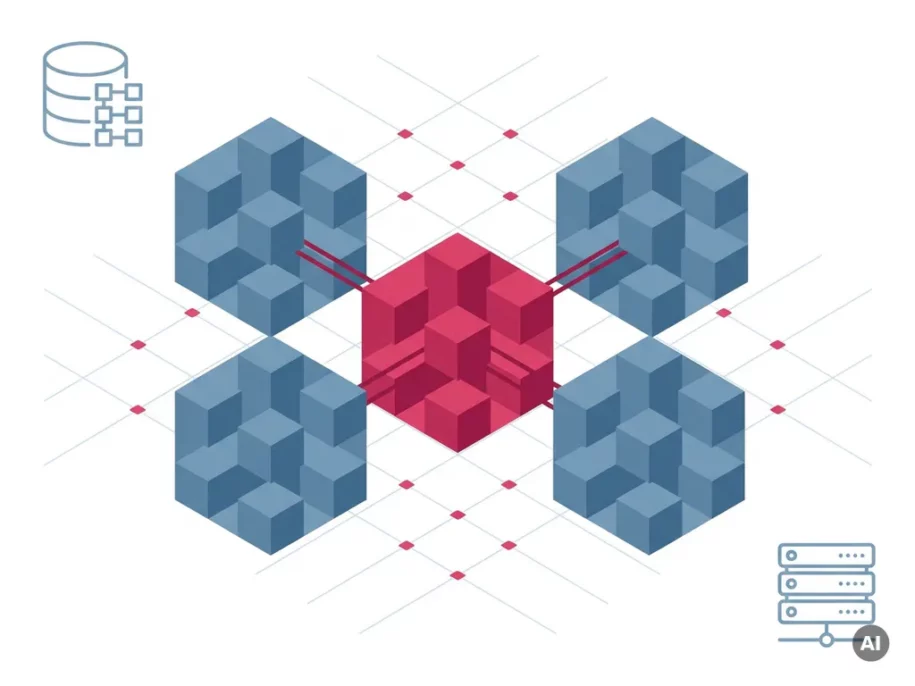
Event-driven architecture (EDA) is a software design pattern where systems communicate by producing, detecting, and reacting to events rather than making direct calls between services. Instead of one component asking another for data, components emit events when something happens, and other components respond to those events asynchronously. This makes EDA a natural fit for real-time data processing, distributed systems, and environments where data volumes and sources are unpredictable. Below, we walk through how event-driven architecture works, what it requires, and how it fits into a modern data platform, with a look at how Stackable supports it at the end.
How does event-driven architecture actually work?
In event-driven architecture, a component called a producer generates an event when something meaningful happens, a user places an order, or a sensor records a temperature reading. That event gets published to a central broker or event bus. One or more consumers subscribe to relevant event types and process them independently, without the producer knowing or caring who is listening.
This decoupled flow means producers and consumers don’t need to be online at the same time, don’t need to know each other’s addresses, and don’t block each other. The broker holds events durably until consumers are ready to process them. That asynchronous model is what gives EDA its scalability and resilience. If one consumer is slow or temporarily unavailable, it simply catches up when it recovers, without affecting the producer or any other consumer.
What are the main components of an event-driven system?
An event-driven system is built from three core components: producers, a broker, and consumers. Producers are any services or applications that generate events. The broker is the central infrastructure that receives, stores, and routes those events. Consumers are services that subscribe to event streams and act on the data they receive.
In practice, most event-driven systems also include a schema registry, which enforces the structure of event payloads so producers and consumers agree on data formats. Monitoring and observability tooling matters just as much, since tracing the flow of events across a distributed system requires dedicated instrumentation. Apache Kafka® is the most widely adopted event broker, offering durable, high-throughput log storage with strong ordering guarantees within partitions. Around it, teams build out the schema management, stream processing, and consumer logic that complete the architecture.
What’s the difference between event-driven and request-driven architecture?
The key distinction comes down to coupling and timing. In a request-driven architecture, one service directly calls another and waits for a response. Both sides must be available at the same time, and the caller is blocked until it gets an answer. In an event-driven architecture, the producer emits an event and moves on immediately, with no expectation of a synchronous reply.
Request-driven communication, REST or gRPC, for example, works well when you need an immediate, consistent response and the interaction is simple and predictable. Event-driven communication works better when you need to fan out data to multiple consumers, when processing can happen asynchronously, or when the volume of interactions makes synchronous calls a bottleneck. Many production systems combine both patterns, using request-driven calls for user-facing queries and event-driven flows for internal data propagation and processing pipelines.
What types of use cases benefit most from event-driven architecture?
Use cases involving high-volume, continuous data streams, or where multiple downstream systems need to react to the same event, are where event-driven architecture delivers the most value. These include fraud detection, real-time analytics, IoT data ingestion, order processing pipelines, and audit logging.
- Fraud detection: Financial transactions can be evaluated against risk models in real time as events flow through the system, without slowing down the transaction itself.
- IoT and sensor data: Devices emit continuous streams of readings that need to be ingested, filtered, and routed to multiple processing systems simultaneously.
- Real-time analytics: Business metrics can be computed continuously from event streams rather than waiting for batch jobs to complete.
- Audit and compliance logging: Every meaningful action in a system can be captured as an immutable event, creating a traceable record without adding synchronous overhead to the originating service.
- Microservices coordination: Services that need to stay loosely coupled but react to each other’s state changes benefit from event-driven integration rather than direct API calls.
How does event-driven architecture fit into a modern data platform?
A modern data platform needs to ingest, process, and serve data from many sources at varying speeds. Event-driven architecture provides the real-time ingestion and routing layer that batch-oriented pipelines simply can’t. It sits between raw data sources and downstream storage, processing, and serving systems, acting as the connective tissue of a data platform architecture.
Event streaming with Apache Kafka® integrates naturally with stream processing frameworks like Apache Spark™ and with analytical storage layers. Events can be written to a data lake or lakehouse in near real time, making fresh data available for both operational and analytical queries without waiting for overnight batch loads. This combination supports architectures that handle both low-latency operational use cases and large-scale historical analysis from the same underlying data.
Event-driven design also aligns well with Data Mesh principles. Domain teams can own and publish their event streams as data products, with consumers subscribing independently. This supports federated governance without creating tight operational dependencies between teams.
What are the challenges of implementing event-driven architecture?
Event-driven architecture introduces real operational complexity. The most common challenges are schema management, consumer ordering guarantees, exactly-once processing semantics, and observability across distributed event flows.
Schema evolution is a persistent difficulty. As producers change event formats over time, consumers must handle both old and new versions without breaking. A schema registry helps, but it requires discipline to maintain. Ordering is another challenge: Kafka guarantees ordering within a partition, but distributing events across partitions for throughput means consumers may see related events out of sequence unless partitioning is designed carefully. Exactly-once semantics, where each event is processed precisely once regardless of failures or retries, require explicit configuration and add overhead. And debugging a distributed event-driven system is harder than tracing a synchronous call chain. Without proper distributed tracing and monitoring, identifying where events are delayed or lost becomes genuinely difficult.
When should an organization adopt event-driven architecture?
Event-driven architecture makes sense when you’re dealing with data volumes or event rates that synchronous systems can’t handle efficiently, when multiple downstream systems need to react to the same data, or when decoupling services is a priority for independent scaling and deployment.
But it’s not the right choice for every situation. Simple CRUD applications, low-traffic internal tools, and use cases that genuinely require synchronous responses are often better served by straightforward request-driven designs. The operational overhead of running and maintaining a distributed event broker like Apache Kafka® is real, and teams should have the engineering capacity to manage it before committing to the pattern. A good signal that EDA is the right move is when you find yourself building workarounds in a synchronous system to handle fan-out, retries, or high-throughput ingestion. Those workarounds are often a sign that an event-driven approach would be cleaner and more maintainable. You can also explore working demos to see how event streaming integrates with broader data platform components before committing to a full architecture decision.
How Stackable supports event-driven architecture
The Stackable Data Platform (SDP) is a modular, Kubernetes-native data platform that includes first-class support for event streaming as a core building block. Rather than treating Apache Kafka® as an add-on, the SDP integrates it as a managed component alongside the rest of the data stack.
- Kubernetes-native operations: The Stackable Operator for Apache Kafka® handles deployment, configuration, scaling, and lifecycle management of Kafka clusters on Kubernetes, reducing the operational burden of running a production event broker.
- Composable architecture: Kafka integrates directly with other SDP components, including Apache Spark™ for stream processing, so event-driven pipelines can be built from modular, interoperable parts without custom glue code.
- Infrastructure as code: All configuration is declarative and version-controlled, making event-driven infrastructure reproducible and auditable across environments, whether on-premises, in the cloud, or in a hybrid setup.
- Data sovereignty: Because the SDP is 100% open source and cloud-agnostic, you run your event infrastructure where your data governance requirements demand, without dependency on a specific cloud provider’s managed services.
If you’re evaluating event-driven architecture for your data platform and want to understand how the SDP fits your specific setup, get in touch with the Stackable team to discuss your requirements.
Ähnliche Artikel
- What is OpenSearch and how does it fit into a modern data platform?
- What is schema evolution and how do open table formats handle it?
- How do you run old and new data platforms in parallel during migration?
- What happens to your data pipelines during a platform migration?
- How do you migrate a data platform without downtime?