


Sharing data between organisations sounds straightforward until you try to do it. Who controls what gets shared? Who can see it, copy it, or repurpose it? What happens when the legal frameworks of two organisations, or two countries, do not align? These questions sit at the centre of every serious cross-organisational data initiative, and they do not have easy answers. Data spaces have emerged as a structured response to exactly this problem, offering a way to exchange data without surrendering control over it. We look at how data spaces work, where they are being applied, and what it takes to participate in one, with a note at the end on how the Stackable Data Platform (SDP) fits into the picture.
The trust problem at the heart of cross-organisational data sharing
The fundamental obstacle to sharing data between organisations is not technical; it is trust. Two companies may both benefit from combining their datasets, but neither wants to hand over raw data to the other without guarantees about how it will be used. Traditional approaches, such as bilateral data-sharing agreements or centralised data lakes, require one party to either trust the other completely or give up meaningful control. Neither option scales well across industries or borders.
This trust deficit has real consequences. Valuable datasets sit siloed inside organisations because the legal, technical, and governance conditions for sharing them safely do not exist. Supply chains cannot be optimised because logistics partners will not expose their operational data. Healthcare research stalls because patient records cannot be combined across hospital systems. The data exists; the mechanism to share it without losing sovereignty does not.
What a data space is and how it works
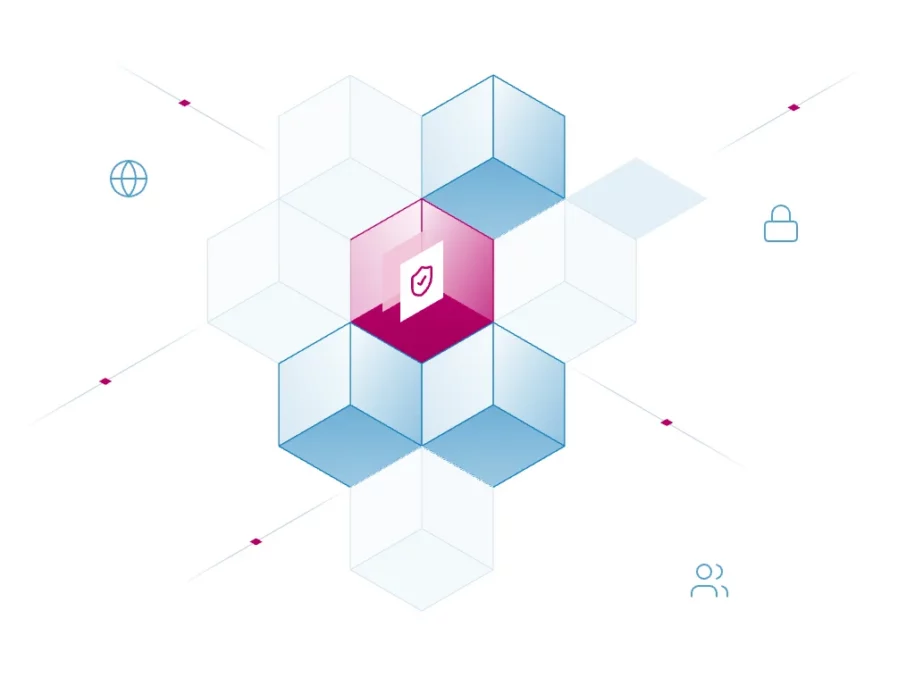
A data space is a federated infrastructure for data exchange that allows participants to share data under agreed rules without centralising it. Unlike a data marketplace or a shared data lake, a data space does not require participants to upload their data to a common repository. Instead, data remains at the source, and access is granted dynamically based on policies that each participant controls.
The core components of a data space typically include a connector layer that mediates data transfers, a catalogue that describes what data is available and under what conditions, and an identity and trust framework that verifies who is participating and whether they are authorised. Initiatives like GAIA-X and the International Data Spaces Association (IDSA) have developed reference architectures for these components, with the IDSA Dataspace Protocol providing a vendor-neutral standard for connector-to-connector communication.
What makes this model different from a simple API integration is the governance layer. Policies travel with the data. A participant can specify that their data may only be used for a defined purpose, only within a certain jurisdiction, or only by verified organisations. These constraints are enforced at the point of exchange, not just agreed in a contract that nobody audits.
How data spaces enforce sovereignty at every exchange
Data sovereignty in a data space context means that the data provider retains meaningful control over their data even after it has been shared. This is enforced through a combination of technical and policy mechanisms that operate at every step of the exchange.
Usage policies, sometimes called usage control policies, define what a recipient can do with data after receiving it. These go beyond access control, which only governs who can retrieve data, and extend into what can be done with it once retrieved. Enforcement mechanisms vary by implementation, but the principle is consistent: the provider’s rules follow the data.
Identity verification is equally important. Data spaces rely on trust anchors, typically accredited certification bodies or identity providers, to confirm that participants are who they claim to be and that they meet the baseline requirements for participation. This is what distinguishes a data space from an open API: entry is conditional, and conditions are verifiable.
Audit trails and logging complete the picture. Because every data exchange is mediated through connectors that record what was shared, with whom, and when, participants can demonstrate compliance with their own policies and with external regulatory requirements. For organisations operating under frameworks like the Digital Operational Resilience Act (DORA) or the NIS-2 Directive, this traceability is not optional.
Sector-specific applications in finance, healthcare, and manufacturing
The abstract architecture of data spaces becomes concrete when you look at where they are being applied. Three sectors illustrate the range of use cases particularly well.
Financial services
In financial services, data spaces are being explored for fraud detection, credit risk assessment, and regulatory reporting. Banks and insurers hold complementary datasets that, if combined, would improve the accuracy of risk models significantly. The challenge is that sharing raw transaction data between competitors raises both competitive and regulatory concerns. A data space allows institutions to contribute to a shared model or analysis without exposing the underlying records, keeping sensitive customer data within each organisation’s own infrastructure.
Healthcare
Healthcare is perhaps the most compelling case. Patient data is among the most sensitive information that exists, and yet its value for medical research, epidemiology, and treatment optimisation is enormous. Data spaces like those being developed under the European Health Data Space (EHDS) initiative aim to make anonymised or pseudonymised patient data available for research while ensuring that hospitals and health systems retain control over what is shared and with whom. The governance model is designed to satisfy both the research community’s need for access and patients’ right to privacy.
Manufacturing and supply chains
In manufacturing, the Catena-X initiative has built a data space specifically for the automotive supply chain. Manufacturers, suppliers, and logistics providers can share production data, quality metrics, and carbon footprint information without exposing proprietary processes. This enables use cases like predictive maintenance across organisational boundaries and end-to-end supply chain visibility, both of which require data from multiple parties but cannot work if any single party has to hand over full access to their systems.
How Kubernetes-native platforms enable data space participation
Joining a data space is not just a governance decision; it requires a technical foundation that can support the connector infrastructure, policy enforcement, and identity management that data spaces depend on. This is where the underlying data platform matters.
Kubernetes-native platforms are well suited to data space participation because they provide the modularity and portability that the connector model requires. A data space connector, such as an IDSA-compliant Eclipse Dataspace Connector (EDC), runs as a containerised workload. It needs to be deployed, configured, monitored, and updated like any other service, and it needs to integrate with the data processing tools that sit behind it. On a Kubernetes-native platform, this integration is handled through standard orchestration patterns rather than bespoke glue code.
The cloud-agnostic nature of Kubernetes also matters here. Data spaces are explicitly designed to avoid creating new forms of lock-in, and a platform that runs consistently across on-premises infrastructure, private cloud, and public cloud environments supports that goal. Organisations that want to participate in a data space without migrating their data to a specific cloud provider need a platform that can operate wherever their data currently lives. You can explore what a data lakehouse with Apache Iceberg and Trino looks like in practice as one example of how composable, open architectures support this kind of flexibility.
Key challenges organisations face when joining a data space
Participation in a data space is not plug-and-play. Organisations consistently encounter a set of challenges that are worth understanding before committing to a specific data space initiative.
The first is governance alignment. Each data space has its own rules for participation, its own trust framework, and its own certification requirements. An organisation that wants to join multiple data spaces may find that the governance models are not fully compatible, requiring separate compliance efforts for each. This is an area where the data space ecosystem is still maturing.
The second challenge is technical integration. Connecting existing data systems to a data space connector requires mapping internal data models to the formats and vocabularies that the data space expects. This is rarely trivial, particularly for organisations with legacy systems or heterogeneous data architectures. Modular data platform solutions that support open standards reduce this friction, but the integration work itself cannot be entirely abstracted away.
The third challenge is organisational. Data spaces require organisations to make explicit decisions about what data they are willing to share, under what conditions, and for what purpose. These decisions involve legal, commercial, and technical stakeholders who do not always agree. Getting internal alignment on data-sharing policy is often harder than the technical implementation.
Finally, there is the question of value. Joining a data space has costs, both in setup and in ongoing participation. Organisations need a clear view of what they expect to gain, whether that is access to data from other participants, improved regulatory compliance, or new commercial opportunities, before committing resources to participation.
The evolving role of data spaces in European data strategy
Data spaces are not a niche technical concept; they are central to the European Union’s strategy for building a competitive, sovereign digital economy. The European Data Strategy, published in 2020 and developed through subsequent legislation, explicitly calls for the creation of common European data spaces across sectors including health, energy, agriculture, finance, and mobility.
The Data Governance Act (DGA), which came into force in 2023, provides the legal framework for data intermediaries, including data space operators, establishing rules for how they must operate and what obligations they carry. The Data Act, which applies from 2025, extends data-sharing obligations to connected devices and cloud services, creating new categories of data that must be made accessible under defined conditions.
GAIA-X, the European initiative for a federated and secure data infrastructure, has provided much of the conceptual and technical groundwork for how data spaces should be structured. While GAIA-X has faced criticism for moving slowly and producing complex specifications, its core contribution, a shared vocabulary and trust framework for federated data exchange, remains relevant to how European data spaces are being built.
The direction is clear: interoperability between data spaces, standardised connectors, and portable governance policies are the building blocks of a European data economy that does not depend on any single platform or provider. For organisations operating in European markets, understanding and engaging with this landscape is increasingly a strategic necessity rather than an optional technical exercise.
How Stackable supports data space participation
The SDP is built around the principles that data spaces depend on: open standards, modular architecture, and data sovereignty by design. For organisations that want to participate in a data space without migrating to a proprietary cloud environment, the SDP provides a practical foundation.
- Cloud-agnostic deployment: The SDP runs on-premises, in any cloud, or in hybrid environments, which means your data stays where it is while you connect to a data space through a compliant connector layer.
- Open-source components: Every component in the SDP is open source, with a fully traceable software supply chain. This supports the transparency requirements that data space trust frameworks typically impose on participants.
- Modular data apps: Tools like Apache Kafka® for event streaming and Trino for federated query can be deployed and managed as Kubernetes-native operators, making it straightforward to build the data processing layer that sits behind a data space connector.
- Policies as Code: The SDP supports federated computational governance through Policies as Code, aligning with the usage control requirements that data spaces enforce at the point of exchange.
- Fair, transparent pricing: Stackable offers community, self-managed, and managed service options, so organisations can start with open source and scale their support level as participation grows.
If you are evaluating how to build or modernise your data infrastructure with data space participation in mind, talk to the Stackable team about what that looks like for your specific environment.
Related Articles
- Who really controls your data platform? - a data-sovereignty check in 7 questions
- What role does Apache Airflow play in orchestrating a lakehouse?
- How does Apache Superset deliver BI on top of a lakehouse?
- What are the hidden costs of staying on a legacy data platform?
- How do you assess data platform migration complexity?