




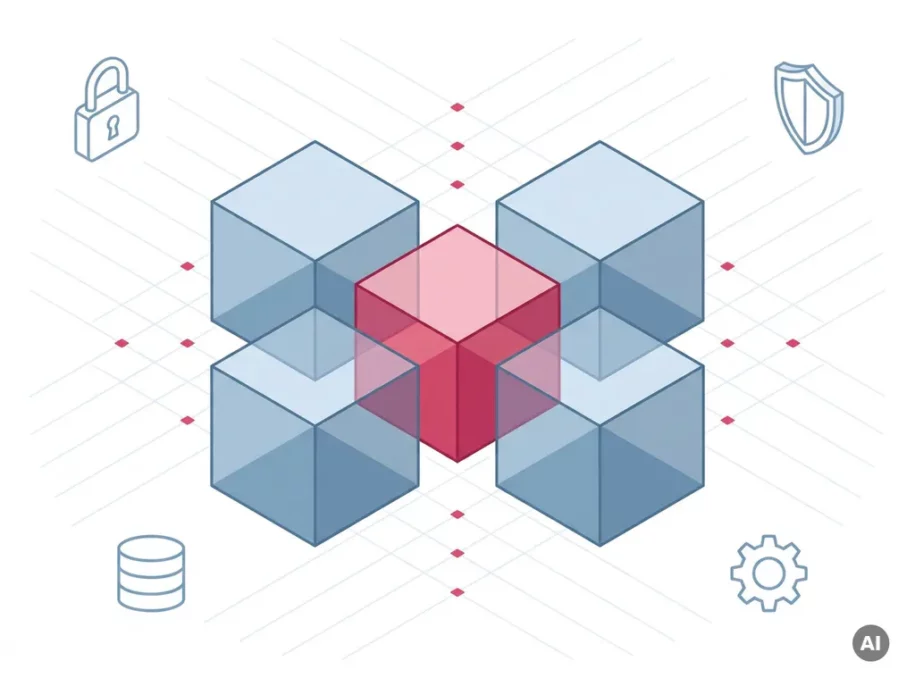
Federated computational governance is a data mesh principle that distributes governance responsibilities across domain teams while enforcing a shared set of global policies through automated, code-driven mechanisms. Instead of relying on a central data team to manually review and approve every data decision, each domain owns its governance locally, but within boundaries the platform enforces automatically. The sections below explain how this works in practice, how it differs from centralized governance, and when it makes sense to adopt it.
At the end, we look specifically at how the Stackable Data Platform (SDP) supports federated computational governance.
How does federated computational governance work in practice?
It works by splitting governance into two layers: global interoperability and compliance policies defined centrally, and domain-level data ownership where individual teams apply and extend those policies within their own boundaries. Automation enforces the global rules consistently, so no central team needs to manually police every data product.
In practice, domain teams publish data products through a self-serve infrastructure layer. Each data product must meet a defined contract, declaring its schema, quality expectations, access controls, and lineage metadata. The platform then validates these declarations automatically before the data product becomes discoverable or usable by other domains.
The key insight is that governance becomes part of the delivery pipeline rather than a separate approval process. Policies are written as code, checked into version control alongside the data product definition, and evaluated at deployment time. A domain team that ships a data product without the required access policy or schema definition simply cannot publish it. The platform blocks it, not a committee.
What are the four principles of data mesh?
The four principles of data mesh are domain-oriented decentralized data ownership, data as a product, self-serve data infrastructure as a platform, and federated computational governance. Together, they describe a sociotechnical approach to managing analytical data at scale in large organizations.
- Domain-oriented decentralized data ownership: Teams that produce data also own and maintain it as a long-term asset, rather than handing it off to a central data team.
- Data as a product: Each domain treats its data outputs as products with defined quality, documentation, discoverability, and consumer-facing contracts.
- Self-serve data infrastructure as a platform: A shared platform layer handles the complexity of storage, compute, and pipelines so domain teams can operate independently without needing deep infrastructure expertise.
- Federated computational governance: Global standards and policies are defined centrally and enforced automatically across all domains, without requiring central teams to manually manage compliance for every data product.
Federated computational governance is what makes the other three sustainable at scale. Without it, decentralization quickly produces inconsistent data quality, incompatible schemas, and compliance gaps that are expensive to fix after the fact.
What is the difference between federated and centralized data governance?
Centralized data governance places all policy definition, enforcement, and oversight with a single team or function. Federated data governance distributes ownership and decision-making to domain teams while keeping a shared set of global standards in place. The key difference is where enforcement happens and who is responsible for day-to-day compliance.
In a centralized model, a data governance office or platform team reviews, approves, and maintains data standards across the organization. This creates a single point of control, which can work well in smaller organizations or where regulatory requirements demand tight oversight. The downside is that it doesn’t scale: as the number of data producers grows, the central team becomes a bottleneck, and domain teams start working around governance rather than with it.
Federated governance shifts responsibility to the teams closest to the data. Domain teams define and maintain their own data products, but within a framework of global policies they did not write and cannot override. The „computational“ part means the platform enforces those global policies automatically, removing the need for a central team to review every change manually.
The practical result is that centralized governance tends to be thorough but slow, while federated computational governance aims to be thorough and fast by automating the enforcement layer. The tradeoff is that federated governance requires a more mature platform and a higher level of trust in domain teams‘ technical capabilities.
What does ‚computational‘ mean in federated computational governance?
„Computational“ means that governance policies are expressed as executable code and enforced automatically by the platform, rather than documented in a handbook and checked by people. Computational governance turns rules into runtime constraints that the infrastructure evaluates without human intervention.
This is a meaningful distinction. In many organizations, data governance exists as a set of written standards: a data catalog policy, a naming convention document, a security checklist. These documents describe what should happen, but they rely on people remembering to follow them and other people reviewing whether they did. Drift is inevitable.
Computational governance makes policies machine-readable and machine-enforced. An access control policy is not a paragraph in a wiki, it is a policy file the platform evaluates every time a data product is deployed or queried. A data quality rule is not a suggestion in a style guide, it is a check that runs in the pipeline and blocks publication if it fails.
This approach also makes governance auditable. Because policies are code, they live in version control. You can see exactly what the policy was at any point in time, who changed it, and what effect that change had. That traceability matters both for internal accountability and for demonstrating compliance to external auditors.
How are global policies enforced across domain teams?
Global policies in a data mesh are enforced through a combination of policy-as-code frameworks, automated pipeline checks, and platform-level controls that apply uniformly to every data product regardless of which domain produced it. Enforcement is structural, not advisory.
The typical enforcement pattern works in layers. At the infrastructure level, the self-serve platform applies baseline controls automatically: network policies, encryption requirements, and access control defaults that domain teams cannot bypass. At the data product level, a schema registry or contract testing framework validates that each data product meets its declared interface before it is published. At the query level, policy engines evaluate access requests in real time against the rules attached to each dataset.
Tools like Open Policy Agent (OPA) are commonly used to express and evaluate these policies in a language-agnostic way. A policy written in OPA can be evaluated by the platform before a data product goes live, ensuring that access controls, tagging requirements, and retention rules are all satisfied. Domain teams interact with these policies by declaring their data product’s metadata and letting the platform validate it, rather than submitting a request to a central team for approval.
The global governance body in a data mesh defines what the policies are, but it does not enforce them manually. Its role shifts from policing to policy design and platform enablement, which is a significant cultural change for organizations used to centralized oversight.
What tools and technologies support federated computational governance?
Federated computational governance is supported by a combination of policy-as-code engines, data cataloging tools, schema registries, pipeline orchestration platforms, and Kubernetes-native infrastructure that can apply controls at the platform level. No single tool covers the entire governance surface.
- Policy-as-code engines: Open Policy Agent (OPA) and similar frameworks allow teams to express access, compliance, and quality rules as code that the platform evaluates automatically.
- Schema registries: Tools like Confluent Schema Registry or Apicurio enforce schema compatibility for event streams, ensuring that producers and consumers agree on data structure without manual coordination.
- Data catalogs: Platforms like Apache Atlas or OpenMetadata provide discoverability, lineage tracking, and metadata management across domains, giving the governance layer visibility into what data products exist and how they are used.
- Pipeline orchestration: Apache Airflow and similar tools can embed governance checks as pipeline steps, blocking data products that fail quality or compliance rules before they reach consumers.
- Kubernetes-native controls: When the data platform runs on Kubernetes, cluster-level policies, via tools like Kyverno or OPA Gatekeeper, can enforce infrastructure-level governance rules across all workloads, regardless of which domain team deployed them.
The choice of tools depends on your existing stack and the specific governance requirements you need to meet. What matters more than any individual tool is that policies are expressed as code, stored in version control, and evaluated automatically rather than manually reviewed after the fact. You can find working demos that show how these components fit together in a Kubernetes-native environment.
When should an organization adopt federated computational governance?
It makes sense when multiple teams are producing data independently, when centralized governance has become a bottleneck, and when the cost of inconsistent data quality or compliance gaps is becoming visible across domains. It is not the right starting point for small teams or organizations with a single data domain.
The clearest signal is when domain teams are waiting weeks for central data governance approvals, or when different teams are producing incompatible versions of the same concept because there is no shared standard they both follow. Both problems indicate that centralized governance is not keeping pace with organizational growth.
Regulatory pressure is another signal. In industries like financial services or healthcare, demonstrating that data access controls, retention policies, and audit trails are consistently applied across all data sources is increasingly required. Computational governance makes that demonstration tractable because the policies are code and the enforcement is automatic, which means you can produce an audit trail without reconstructing it manually.
Organizations that are not yet ready for federated computational governance typically share a few characteristics: fewer than three or four distinct data-producing domains, a data platform managed by a single team, or no self-serve infrastructure layer yet in place. Adopting federated governance before those foundations exist tends to produce complexity without the corresponding benefit. The governance framework needs a platform to enforce it, and that platform needs to be mature enough that domain teams can operate it independently.
How Stackable supports federated computational governance
The Stackable Data Platform (SDP) is built with data mesh architectures in mind, and federated computational governance is a core design concern, not an afterthought. Here is what that looks like concretely:
- Policies as code: The SDP uses a Policies as Code approach, allowing governance rules to be defined declaratively, stored in version control, and enforced automatically across all workloads running on the platform.
- Kubernetes-native enforcement: Because the SDP runs on Kubernetes, cluster-level controls apply uniformly to every operator and data product, regardless of which domain team deployed them. There is no way to bypass platform-level policies by deploying outside the standard path.
- Modular, composable architecture: Domain teams can add or remove data tools, including Apache Kafka®, Trino, and Apache Spark™, without rebuilding the governance layer. Each operator integrates with the platform’s shared security and access control model.
- Data sovereignty by design: The SDP is 100% open source and cloud-agnostic, so organizations can enforce governance policies in their own data center, in any cloud, or in a hybrid environment, without depending on a specific provider’s governance tooling.
- Fully traceable software supply chain: Every component of the SDP is auditable, which directly supports the auditability requirements that computational governance depends on.
If you are evaluating how to implement federated computational governance on a Kubernetes-native open-source platform, get in touch with the Stackable team to discuss your architecture, or explore the platform solutions to see how the SDP fits your use case.
Ähnliche Artikel
- How do you secure a data lakehouse against unauthorized access?
- What is an open table format and why does it matter for data lakehouses?
- What roles and responsibilities exist in a data mesh team?
- What are the biggest challenges of data mesh implementation?
- How do you migrate a data platform in a regulated industry?